

Risk management is one of the foundational concepts in cybersecurity — and one of the most misunderstood. Many engineers treat it as a compliance checkbox. In reality, it is the thinking framework behind every security decision.
I am currently preparing for the ISC2 CC certification, and risk management is one of the core domains. Here is how I structured the key concepts into a practical mental model.
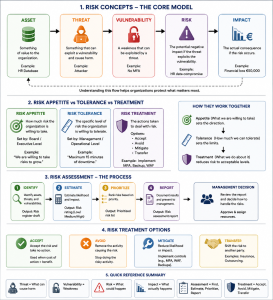
1. The Core Model: Asset → Threat → Vulnerability → Risk → Impact
Every risk story follows the same flow:
An Asset is something of value to the organization — a database, a service, customer data. A Threat is something that can exploit a weakness — an attacker, a misconfiguration, a natural disaster. A Vulnerability is the weakness itself — no MFA, an unpatched system, an open port. Risk is the potential negative impact if the threat exploits the vulnerability. Impact is the actual consequence — financial loss, reputational damage, operational downtime.
Understanding this flow helps organizations protect what matters most, not just what looks scary.
2. Risk Appetite vs Risk Tolerance vs Risk Treatment
These three concepts are often confused.
Risk Appetite is how much risk the organization is willing to take. It is set at the Board or Executive level. Example: “We are willing to take risks to grow.”
Risk Tolerance is the specific level of risk the organization can tolerate operationally. It is set by Management. Example: “Maximum 15 minutes of downtime.”
Risk Treatment is what you actually do about a risk. Options are: Accept, Avoid, Mitigate, or Transfer.
3. Risk Assessment — The Process
Risk assessment follows four steps: Identify assets, threats, and vulnerabilities. Estimate likelihood and impact. Prioritize risks based on severity. Report findings to management for decision.
The output is a prioritized risk list that management uses to allocate resources.
4. Risk Treatment Options
Accept — the cost of action is greater than the benefit. Take no action but document the decision.
Avoid — remove the activity causing the risk entirely.
Mitigate — reduce the likelihood or impact. Implement controls such as MFA, WAF, or backups.
Transfer — shift the risk to another party. Examples include insurance or outsourcing.
Conclusion
Risk management is not about eliminating all risk. It is about making conscious, informed decisions about which risks to accept, which to mitigate, and which to transfer.
This mental model applies equally to a CISO making strategic decisions and to a Cloud Architect designing a new system. Every architecture decision is a risk decision.
If you are preparing for ISC2 CC or simply want to think more clearly about security — start here.