

Introduction
The CIA Triad cloud architecture framework — Confidentiality, Integrity, Availability — is one of the first things you encounter when studying cybersecurity.
But here is the thing: simple frameworks are not always shallow ones. After years of designing cloud infrastructure and working through production incidents, I have started to appreciate how much engineering clarity you can get from asking just one question before designing or changing a system: what are we actually protecting here?
The CIA Triad does not answer that question for you. What it does is give you a structure to think through the answer — and that is more valuable than most people credit it for.
Security Is Not a Tool. It Is a Way of Making Decisions.
There is a common pattern in engineering teams. Someone proposes adding a WAF, rotating credentials, or enabling encryption at rest, and the conversation immediately jumps to implementation: which service, which config, which ticket. The why gets skipped.
Security is often treated as a layer you bolt on after the architecture is decided. Firewall at the edge. Antivirus on the endpoints. Checkbox ticked. Ship it.
That approach does not hold up well under pressure. When an incident happens — a data exposure, an unexpected service outage, a compromised credential — what fails is rarely the tool. What fails is the reasoning behind it. Nobody asked the right questions before the system was built.
This is where a framework like the CIA Triad earns its place. Not as a compliance checklist, but as a thinking tool. It forces you to define what matters before you decide how to protect it.
CIA Triad Cloud Architecture in Practical Terms
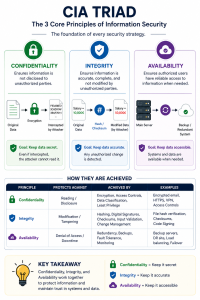
Confidentiality
Confidentiality is about making sure data is only accessible to people and systems that are supposed to have access to it. Not just at rest. Not just in transit. Across the entire data lifecycle. When you think about confidentiality in a cloud context, you are thinking about IAM policies, encryption keys, S3 bucket permissions, secrets management, and network segmentation.
The practical question is not “is our data encrypted?” It is “who can actually read this data, and is that the right set of people and services?”
Integrity
Integrity is about making sure data is accurate and has not been tampered with — intentionally or accidentally. This is the property that is easiest to overlook because it is less visible than a breach and less dramatic than an outage. But data that has been silently corrupted or quietly modified is often worse than data that is simply unavailable. At least an outage is obvious.
In engineering terms, integrity shows up in hashing, checksums, digital signatures, database transaction controls, and audit logs. The question is: “how do we know this data has not changed since we last trusted it?”
Availability
Availability is about making sure the systems and data that need to be reachable, are reachable — when they need to be. This is the property most cloud architects spend the most time on, and for good reason. Downtime is expensive and visible. But availability is not just about uptime percentages. It is about recovery time when things go wrong, and how gracefully the system degrades when components fail.
Mapping CIA to Real Cloud Architecture
These three properties are not abstract. They map directly to the engineering decisions you make every day.
Confidentiality in Practice
- S3 bucket policies and block public access settings — a misconfigured bucket is one of the most common causes of unintended data exposure in AWS environments.
- IAM least privilege — every role and policy should grant only what is actually required. Overly permissive IAM is a confidentiality failure waiting to happen.
- Encryption at rest and in transit — KMS-managed keys for sensitive workloads, TLS enforced on all service endpoints.
- Secrets Manager or Parameter Store for credentials — not environment variables baked into container images.
Integrity in Practice
- S3 Object Integrity and checksums — verifying that files have not been modified or corrupted during transfer.
- Digital signatures on infrastructure artifacts — signed AMIs, signed container images, signed deployment packages.
- CloudTrail and audit logging — an immutable record of who did what and when. If something changes, you want to know about it.
- Database write protections and input validation — integrity failures often start at the application layer before they reach storage.
Availability in Practice
- Multi-AZ deployments — distributing workloads across availability zones so a single failure does not take down the service.
- RDS automated backups and point-in-time recovery — knowing that you can restore to a known-good state within a defined window.
- Route 53 health checks and failover routing — automatic traffic rerouting when an endpoint becomes unhealthy.
- Disaster Recovery architecture — not just having a DR plan, but having tested it. A backup you have never restored is not a backup; it is an assumption.
The Trade-offs Are the Real Engineering Work
Here is something that the textbooks tend to underemphasise: improving one CIA property often puts pressure on another. These are not three independent dials you can turn up simultaneously without consequence.
Encryption improves confidentiality, but it adds operational complexity. You need key management, key rotation policies, and careful handling of key access. If you encrypt everything aggressively without planning for key recovery, you can create availability problems of your own making.
High availability architectures — multi-region active-active setups, real-time replication, global load balancing — improve the A in CIA significantly. They also increase cost, network complexity, and the attack surface. More components mean more potential failure points and more potential entry points.
Integrity controls like strict audit logging, database transaction validation, and cryptographic verification of artifacts add operational overhead. They slow down some workflows. They create dependencies on logging infrastructure that itself needs to be protected and available.
A payment processing system probably prioritises integrity above everything else. A real-time telemetry pipeline might tolerate some data loss in exchange for scale and throughput. A document storage service for legal records has hard confidentiality requirements that override almost any convenience optimisation. The CIA Triad helps you have that conversation with your team, your stakeholders, and your own design instincts.
A Practical Checklist Before You Build or Change Anything
Before designing a new system, changing an existing architecture, or reviewing a security posture, these five questions are worth writing down:
- What are we protecting? — Name the specific data, service, or capability. Vague answers produce vague protections.
- Who should have access? — List the people and systems that legitimately need it. Start from zero and add, rather than starting from full access and restricting.
- What must not be changed without authorisation? — Identify the data and configuration that, if tampered with, would cause the most damage or be the hardest to detect.
- What must remain available, and at what recovery time? — Define the availability requirement explicitly. RTO and RPO are not bureaucratic metrics; they are engineering constraints.
- What is the business impact if this fails? — This connects the technical design to the actual risk. It also helps prioritise where to spend engineering effort.
These questions do not replace threat modelling, architecture reviews, or compliance frameworks. They are a starting point — a way to make sure the fundamentals are visible before the complexity begins.
Architect’s Note
I am currently studying for the ISC2 Certified in Cybersecurity (CC) certification, and I have been deliberately writing about the concepts I am working through — not to summarise them, but to connect them to the infrastructure decisions I have made over the years in cloud and production environments.
The CIA Triad is lesson one for a reason. It is not the most sophisticated framework in security. But it is the one that most reliably surfaces the question that should come before every other question: what are we actually trying to protect, and why does it matter?
I would rather have an engineering team that asks that question reflexively than one that has memorised every compliance acronym in the industry.